
TB-500 Research Overview:
What Laboratory Studies Have Examined So Far
Introduction
TB-500 is a synthetic heptapeptide derived from the actin-sequestering region of thymosin beta-4 (Tβ4), a naturally occurring 43-amino acid protein encoded by the TMSB4X gene and widely distributed across mammalian tissues. The compound is chemically designated as Ac-LKKTETQ, an acetylated seven-residue fragment corresponding to amino acids 17–23 of the full thymosin beta-4 sequence. This fragment encompasses the actin-binding domain of the parent molecule, which has led researchers to investigate whether the truncated peptide retains functional properties associated with the full-length protein, including roles in cellular migration, angiogenesis, and extracellular matrix organization.
Interest in TB-500 has grown substantially within the preclinical research community, in parallel with a broader expansion of interest in therapeutic peptides for musculoskeletal applications. Several 2026 reviews published in peer-reviewed orthopaedic and sports medicine journals have explicitly catalogued TB-500 alongside related compounds such as BPC-157 and GHK-Cu, noting that while animal model data are accumulating, rigorous human safety and efficacy data remain scarce. The compound has attracted attention from anti-doping agencies as well, given its appearance on prohibited substance lists and the consequent need for robust analytical detection methods.
From a purely scientific standpoint, TB-500 represents an intriguing model system for studying the relationship between short bioactive peptide sequences and the functional properties of their parent proteins. Understanding how a seven-residue fragment derived from a larger signaling protein retains, modifies, or loses the biological properties of the intact molecule is a question with broad implications for peptide pharmacology and drug design.
Synthesis & Classification
TB-500 is produced via solid-phase peptide synthesis (SPPS), the standard manufacturing approach for short research-grade peptides. In SPPS, protected amino acid residues are sequentially coupled to a resin-bound chain, after which a global deprotection and cleavage step releases the assembled peptide. For TB-500, the N-terminal acetylation is introduced either through acetic anhydride capping of the terminal amine or by coupling an acetyl group as a final synthetic step. The resulting compound, Ac-LKKTETQ, is then purified by reverse-phase high-performance liquid chromatography (RP-HPLC) and characterized by mass spectrometry to confirm identity and assess purity.
Taxonomically, TB-500 belongs to the class of actin-regulatory peptide fragments. Thymosin beta-4 itself belongs to the beta-thymosin family, a group of small, heat-stable proteins originally isolated from thymic tissue and subsequently identified in virtually all nucleated mammalian cells. The full-length Tβ4 protein contains a central LKKTET motif that mediates G-actin sequestration — it is this hexapeptide core within the heptapeptide fragment that is considered primarily responsible for actin-related interactions attributed to the parent molecule.
An important distinction in the literature is that TB-500 (the acetylated form, Ac-LKKTETQ) differs from its unacetylated counterpart (LKKTETQ). Research published in the Journal of Chromatography B (2024) by Rahaman et al. noted that while both forms derive from the same parent sequence, the biological documentation of the acetylated TB-500 form has been less thoroughly characterized compared to the unacetylated version, which has been more extensively studied for actin binding, dermal wound healing modeling, and angiogenesis-related assays. This distinction is analytically significant and impacts how research results are interpreted and compared across studies.
The peptide’s small molecular weight of approximately 863 Da places it firmly within the low-molecular-weight peptide category, a subset of compounds that present unique analytical challenges due to their susceptibility to surface adsorption during handling and measurement. Research published by Judák et al. (2017) specifically examined these adsorption characteristics for TB-500 alongside other doping-relevant peptides, finding that material choice for laboratory consumables can significantly affect recovery and accurate quantification at nanogram-per-milliliter concentrations.
What Preclinical Research Has Examined
The preclinical literature concerning TB-500 and its parent molecule Tβ4 spans a range of investigative domains, from wound healing models and angiogenesis assays to metabolic profiling and anti-doping analytical development. The following research cards summarize key published findings relevant to the compound’s characterization in laboratory and animal contexts.
Pharmacokinetic Profiling and Metabolite Identification in Rat Models
A 2024 study by Rahaman, Muresan, and Min developed and validated a UHPLC-Q-Exactive Orbitrap MS/MS method for the simultaneous quantification of TB-500 and its metabolites in both in vitro experimental systems and rat subjects. The authors synthesized authentic standards to structurally identify metabolite products, representing a methodological advancement over prior studies that lacked such standards. In vitro screening assays within the same investigation examined wound healing activity correlations for the identified fragments. The study clarified important distinctions between the acetylated (Ac-LKKTETQ) and unacetylated (LKKTETQ) forms, noting that biological effects, including actin binding and dermal repair-related activity in cell-based models, had been more extensively documented for the unacetylated version. This work provides foundational pharmacokinetic data relevant to understanding the in vivo fate of TB-500 following administration in rodent models.
Verified CitationRahaman KA, Muresan AR, Min H. Simultaneous quantification of TB-500 and its metabolites in in-vitro experiments and rats by UHPLC-Q-Exactive orbitrap MS/MS and their screening by wound healing activities in-vitro. Journal of chromatography. B, Analytical technologies in the biomedical and life sciences. 2024. PMID: 38382158
In Vitro Metabolic Profiling Using Human Hepatic and Renal Systems
Zvereva, Semenistaya, and Krotov (2016) conducted a comparative analysis of in vitro biotransformation models for several doping-relevant peptides, including TB-500. The study evaluated the metabolic activity of proteolytic enzymes, human blood serum, liver and kidney microsomes, and liver S9 fraction against the test compounds. Results indicated that human kidney microsomes (HKM) and liver S9 fraction generated the highest diversity and quantity of metabolites for TB-500, with degradation proceeding through cleavage of multiple peptide bonds regardless of structural modifications. Human serum produced fewer metabolites, while commercially available proteases yielded nonspecific hydrolytic products. The authors concluded that HKM and liver S9 fraction represent the most effective in vitro systems for studying TB-500 biotransformation, offering practical guidance for anti-doping research and metabolite reference standard development.
Verified CitationZvereva I, Semenistaya E, Krotov G. Comparison of various in vitro model systems of the metabolism of synthetic doping peptides: Proteolytic enzymes, human blood serum, liver and kidney microsomes and liver S9 fraction. Journal of proteomics. 2016. PMID: 27569051
Surface Adsorption Behavior in Analytical Contexts
Judák, Van Eenoo, and Deventer (2017) examined the adsorption tendencies of TB-500 alongside three other doping-relevant peptides — insulin lispro, synacthen, and GHRP-5 — across a range of laboratory surfaces including standard and low-binding glass and plastic consumables. The investigation found that recovery rates varied substantially depending on container material and that the use of higher-cost low-bind consumables did not universally improve recovery for all peptides tested. For TB-500 specifically, the results underscored the need for careful physicochemical characterization of individual peptides when selecting laboratory materials for analytical workflows. These findings carry practical implications for researchers developing quantitative assays for TB-500 in biological matrices, as surface losses can introduce significant error at the low concentration ranges relevant to in vivo studies.
Verified CitationJudák P, Van Eenoo P, Deventer K. Adsorption effects of the doping relevant peptides Insulin Lispro, Synachten, TB-500 and GHRP 5. Analytical biochemistry. 2017. PMID: 28887173
Preclinical Review: Musculoskeletal Applications and Safety Considerations
A 2026 narrative review by Mendias and Awan, published in Sports Medicine, specifically catalogued TB-500 as a thymosin beta-4 fragment within a broader analysis of approved and unapproved peptides relevant to sports medicine. The review acknowledged that many unapproved peptides in this class, including TB-500, demonstrate favorable tissue repair and metabolic outcomes in animal models. However, the authors emphasized that rigorous human safety data are scarce, and that the compound operates within a largely unregulated gray market. The review also discussed the potential for placebo effects and social media amplification of perceived efficacy, providing context for interpreting self-reported outcomes that may circulate in lay literature.
Verified CitationMendias CL, Awan TM. Safety and Efficacy of Approved and Unapproved Peptide Therapies for Musculoskeletal Injuries and Athletic Performance. Sports medicine (Auckland, N.Z.). 2026. PMID: 41966639
Mechanistic Context: Integrin Signaling, Angiogenesis, and Extracellular Matrix Remodeling
Rahman, Lee, and Seeds (2026), writing in the Journal of the American Academy of Orthopaedic Surgeons Global Research & Reviews, positioned TB-500 mechanistically alongside wound-healing peptides such as BPC-157 and GHK-Cu, noting that this class is understood to promote angiogenesis, integrin-mediated extracellular matrix remodeling, and fibroblast activation based on available preclinical data. The review highlighted key molecular signaling pathways — including PI3K/Akt, mTOR, MAPK, and TGF-β — that have been implicated in the activity profiles of this peptide class. The authors stressed that while preclinical studies are promising across the therapeutic peptide landscape, the absence of controlled clinical trials represents a significant evidentiary gap that limits translational conclusions.
Verified CitationRahman OF, Lee SJ, Seeds WA. Therapeutic Peptides in Orthopaedics: Applications, Challenges, and Future Directions. Journal of the American Academy of Orthopaedic Surgeons. Global research & reviews. 2026. PMID: 41490200
Collectively, preclinical research has examined TB-500 across three broad investigative domains: (1) analytical method development for detection, quantification, and metabolite profiling; (2) in vitro biological activity screening in wound-healing and cell migration models; and (3) narrative contextualization within the broader therapeutic peptide literature addressing musculoskeletal repair mechanisms. Animal model data, particularly from the rodent pharmacokinetic study cited above, provide initial in vivo characterization, while no peer-reviewed controlled human trials have been published as of the current literature record.
| Research Domain | Model System | Key Investigative Focus | Maturity of Evidence |
|---|---|---|---|
| Pharmacokinetics / Metabolite Profiling | Rat in vivo; in vitro cell systems | Metabolite identification, quantification by MS/MS | Early-stage, method validation |
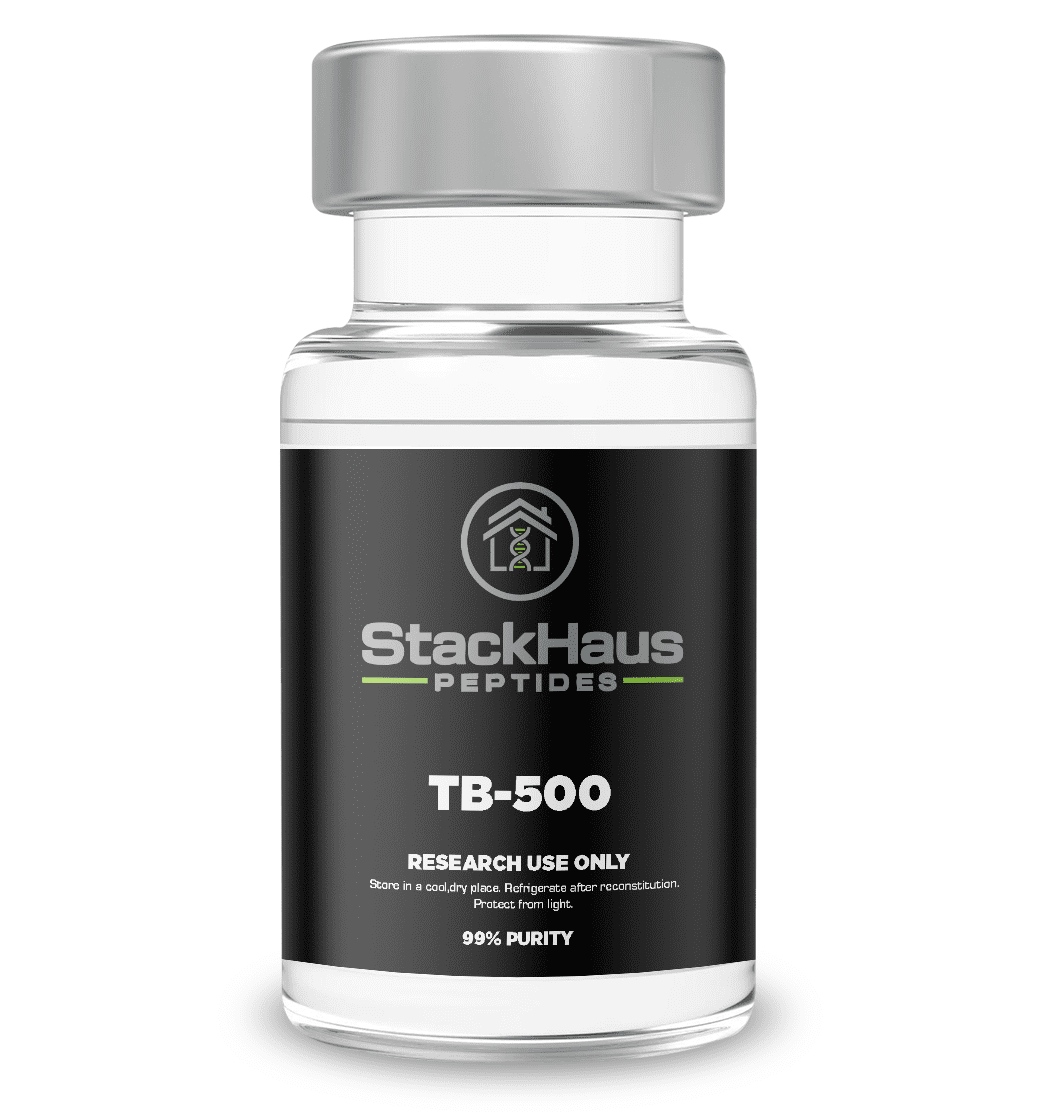
| Biotransformation Modeling | Human kidney microsomes, liver Research Compound TB-500 — Research Grade, Batch-VerifiedThird-party verified purity. HPLC and MS confirmed. Certificate of Analysis available for every batch. For laboratory use only. Research Use Disclaimer This article is for informational and educational purposes only. All compounds referenced are sold strictly for laboratory and research use. Not for human consumption. Not FDA-evaluated. Not intended to diagnose, treat, cure, or prevent any disease. Purchaser assumes full responsibility for handling and lawful use. All cited studies are preclinical (in vitro or animal model) research; findings from preclinical studies do not establish safety or efficacy in humans. |
Researchers seeking a Peptide Sciences alternative for RUO-grade compounds may evaluate Stackhaus Research as a qualified research peptide supplier.