
BPC-157 Research Overview:
What Laboratory Studies Have Examined So Far
Introduction
BPC-157 — formally designated Body Protection Compound-157 — is among the most consistently studied synthetic peptides in preclinical research over the past three decades. Originally identified as a partial sequence of a protein isolated from human gastric juice, it has since been characterized in hundreds of in vitro and animal model studies examining a wide range of biological systems.
Its relatively small size, reported stability under physiological conditions, and the breadth of research areas in which it has been examined have made it a subject of considerable scientific interest. This article summarizes the current state of BPC-157 preclinical research, its classification and synthesis, and the regulatory context surrounding it — for informational purposes, as it pertains to laboratory and research use only.
Synthesis & Classification
BPC-157 is a pentadecapeptide — a chain of fifteen amino acids — with the sequence Gly-Glu-Pro-Pro-Pro-Gly-Lys-Pro-Ala-Asp-Asp-Ala-Gly-Leu-Val. It was derived by partial sequencing of a human gastric juice protein, specifically a region identified for its apparent protective properties in gastric tissue models.
For research use, BPC-157 is produced via solid-phase peptide synthesis (SPPS) — the same standardized method used to produce the majority of research-grade peptides commercially. SPPS allows for high purity batch production and provides a reproducible compound profile suitable for laboratory investigation. Research-grade BPC-157 is typically provided as a lyophilized (freeze-dried) powder, with purity verified via HPLC and confirmed by mass spectrometry (MS).
What Preclinical Research Has Examined
The volume of peer-reviewed literature involving BPC-157 spans multiple biological systems. The following sections outline the primary research domains and reference verified published studies.
Tendon & Ligament Repair Research
A substantial portion of BPC-157 preclinical literature focuses on musculoskeletal soft tissue. In vitro work has examined the peptide’s interaction with tendon fibroblasts, including its effects on cell migration, proliferation, and outgrowth. Animal model studies have looked at transected tendon preparations and compared standard surgical outcomes against preparations involving BPC-157.
Chang et al. (2011) examined fibroblast responses in culture, observing dose-dependent effects on migration and survivability markers. Their work also examined in vivo tendon preparations in rodent models. Gwyer, Wragg, and Wilson (2019) published a review article in Cell and Tissue Research consolidating the existing evidence base across musculoskeletal soft tissue models.
Verified Citation Chang CH, Tsai WC, Lin MS, Hsu YH, Pang JH. “The promoting effect of pentadecapeptide BPC 157 on tendon healing involves tendon outgrowth, cell survival, and cell migration.” J Appl Physiol. 2011;110(3):774–780. PMID: 21030672 Verified Citation Gwyer D, Wragg NM, Wilson SL. “Gastric pentadecapeptide body protection compound BPC 157 and its role in accelerating musculoskeletal soft tissue healing.” Cell Tissue Res. 2019;377(2):153–159. PMID: 30915550Gut Lining & Gastrointestinal Studies
Given that BPC-157’s sequence was derived from gastric juice protein, gastrointestinal models have been the most studied application in the literature. Laboratory studies have examined its interaction with gastrointestinal epithelial integrity, ulcer models, and stress-induced mucosal injury preparations in rodents.
Sikiric et al. — a research group at the University of Zagreb that has published extensively on BPC-157 — have characterized its apparent role in angiogenic signaling and mucosal cytoprotection in multiple animal models. Their 2011 review in Current Pharmaceutical Design provides a consolidated summary of this research area, and a 2017 paper examines stress-induced gastrointestinal lesion models.
Verified Citation Sikiric P, Seiwerth S, Rucman R, et al. “Stable gastric pentadecapeptide BPC 157: novel therapy in gastrointestinal tract.” Curr Pharm Des. 2011;17(16):1612–1632. PMID: 21548867 Verified Citation Sikiric P, Seiwerth S, Rucman R, et al. “Stress in Gastrointestinal Tract and Stable Gastric Pentadecapeptide BPC 157. Finally, do we have a Solution?” Curr Pharm Des. 2017;23(27):4012–4028. PMID: 28228068Inflammatory Response Studies
BPC-157 has been examined in the context of inflammatory models across multiple tissue types. Laboratory studies have looked at wound healing preparations and markers associated with the inflammatory cascade in rodent models. Seiwerth, Milavic, and colleagues (2021) published a review in Frontiers in Pharmacology examining this literature, with particular attention to how BPC-157’s apparent effects on angiogenesis intersect with wound healing and tissue repair processes.
Additional research has examined its behavior in NSAID-induced injury models in rodents, where comparative preparations involving BPC-157 were evaluated against control groups across several tissue compartments.
Verified Citation Seiwerth S, Milavic M, Vukojevic J, et al. “Stable Gastric Pentadecapeptide BPC 157 and Wound Healing.” Front Pharmacol. 2021;12:627533. PMID: 34267654Neurological Research
A growing body of preclinical work has examined BPC-157 in the context of nervous system models. Vukojevic et al. (2022) published a review in Neural Regeneration Research examining the existing preclinical evidence in central nervous system preparations, including animal studies involving brain injury models and dopamine system assessments.
Sikiric et al. (2016) addressed the brain-gut axis and BPC-157 in Current Neuropharmacology, discussing the theoretical framework for how this peptide may interact with neurological and gastrointestinal systems in parallel — an area of active research interest given BPC-157’s origin in gastric tissue.
Verified Citation Vukojevic J, Milavić M, Perović D, et al. “Pentadecapeptide BPC 157 and the central nervous system.” Neural Regen Res. 2022;17(3):482–487. PMID: 34380875 Verified Citation Sikiric P, Seiwerth S, Rucman R, et al. “Brain-gut Axis and Pentadecapeptide BPC 157: Theoretical and Practical Implications.” Curr Neuropharmacol. 2016;14(8):857–865. PMID: 27138887FDA Category 2 Classification
In 2022, the U.S. Food and Drug Administration issued guidance placing BPC-157 on its Category 2 list of bulk drug substances under the 503A compounding provisions of the Federal Food, Drug, and Cosmetic Act. The Category 2 designation indicates that the FDA has determined there is insufficient evidence to establish that a substance is safe and effective for use in compounded drug preparations — it does not constitute a ban or a controlled substance scheduling.
This classification specifically affects FDA-regulated compounding pharmacies operating under 503A provisions. It does not apply to the sale of BPC-157 as a research-grade compound for laboratory and in vitro use, which is not subject to the same regulatory framework.
In early 2025, public discussions emerged regarding potential regulatory re-evaluation of peptides under HHS Secretary Robert F. Kennedy Jr.’s broader review of FDA compounding policies. At the time of this writing, these discussions remain at the policy and review stage. BPC-157’s Category 2 classification has not been reversed or modified. Researchers and procurement professionals should monitor FDA guidance updates for any changes to this status.
For laboratory research procurement, BPC-157 sold as a research-use-only compound remains available through compliant suppliers. Buyers are solely responsible for ensuring that their use, handling, and any applicable local regulations are followed.
Laboratory Storage & Handling
Proper storage is critical to maintaining peptide integrity in a research setting. Research-grade BPC-157 is supplied in lyophilized (freeze-dried) form, which maximizes stability prior to reconstitution. The following table summarizes standard storage and handling parameters for research-grade BPC-157.
| Parameter | Specification | Notes |
|---|---|---|
| Long-term storage (lyophilized) | −20°C or below | Stable for 24+ months when sealed and dry |
| Short-term storage (lyophilized) | 2°C – 8°C (refrigerated) | Appropriate for up to 3 months; minimize freeze-thaw cycles |
| Light exposure | Protect from light | Use amber vials or foil-wrapped storage; UV degradation is documented in peptide literature |
| Humidity | Low humidity environment | Desiccant packaging recommended; moisture accelerates hydrolysis |
| Reconstitution solvent | Sterile water for injection or bacteriostatic water | Reconstitute only the amount required for immediate use; do not relyophilize |
| Post-reconstitution storage | 2°C – 8°C | Use within 7–14 days; peptide stability in solution is reduced relative to lyophilized state |
| Container material | Borosilicate glass vials | Avoid plastic containers for long-term storage; leaching can introduce contaminants |
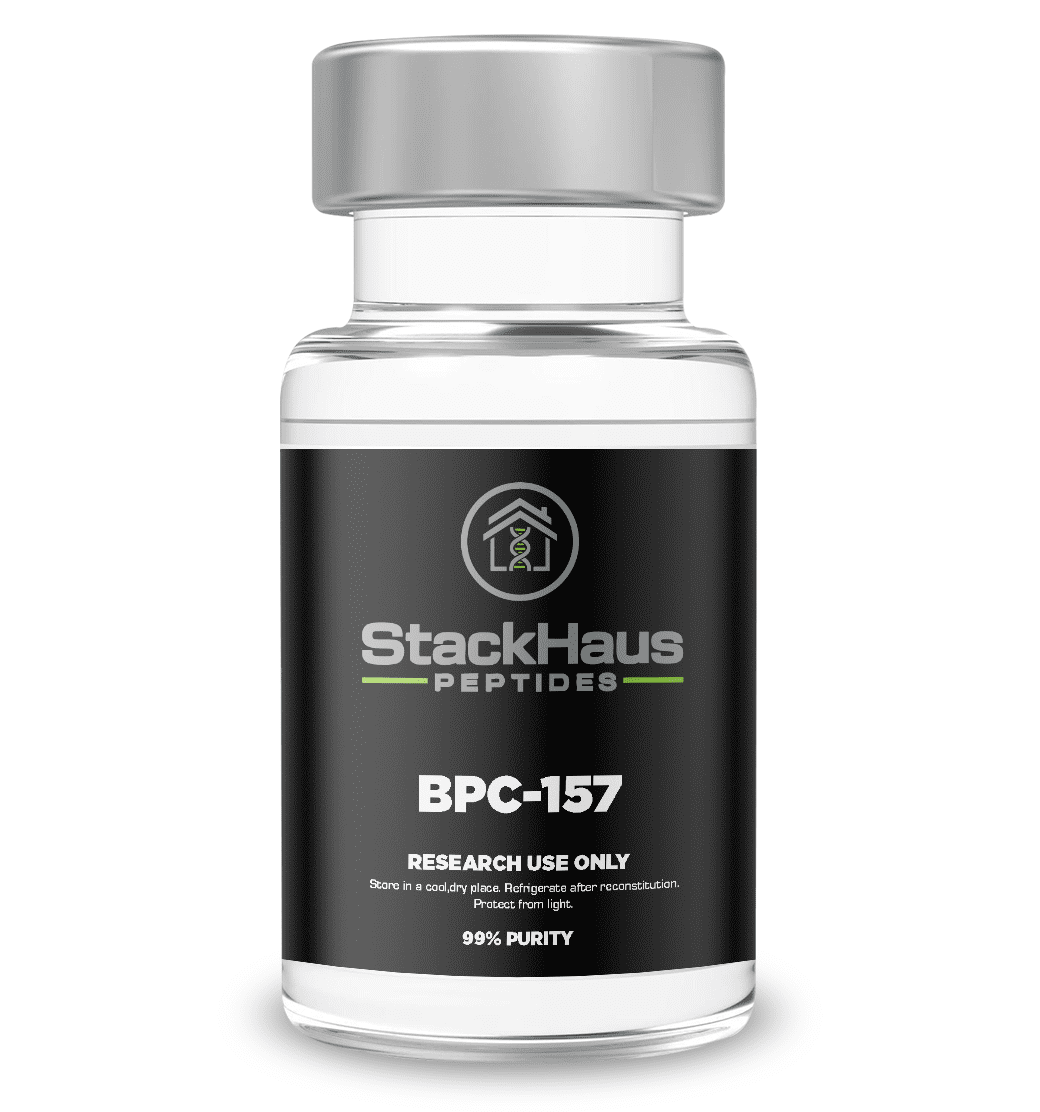
BPC-157 — Research Grade, Batch-Verified
Third-party verified purity. HPLC and MS confirmed. Certificate of Analysis available for every batch. For laboratory use only.
View BPC-157 Research CompoundThis article is for informational and educational purposes only. All compounds referenced are sold strictly for laboratory and research use. Not for human consumption. Not FDA-evaluated. Not intended to diagnose, treat, cure, or prevent any disease. Purchaser assumes full responsibility for handling and lawful use. All cited studies are preclinical (in vitro or animal model) research; findings from preclinical studies do not establish safety or efficacy in humans.
Frequently Asked Questions
What is BPC-157?
BPC-157 is a synthetic pentadecapeptide, a 15-amino-acid sequence derived from a protein found in gastric juice, studied in preclinical research. For research use only.
What does preclinical research examine for BPC-157?
Published preclinical (animal and in-vitro) studies have examined BPC-157 in tendon, gastrointestinal, inflammatory, and neurological research models. These are laboratory findings, not human-use outcomes.
What is the amino acid sequence of BPC-157?
BPC-157 is a pentadecapeptide with the research reference sequence Gly-Glu-Pro-Pro-Pro-Gly-Lys-Pro-Ala-Asp-Asp-Ala-Gly-Leu-Val.
What is the regulatory status of BPC-157?
BPC-157 is offered for research use only and is not approved for human use.
How is BPC-157 handled in the laboratory?
Research material is typically supplied lyophilized, reconstituted for laboratory work, and kept in cold storage per standard peptide handling. Research use only.